
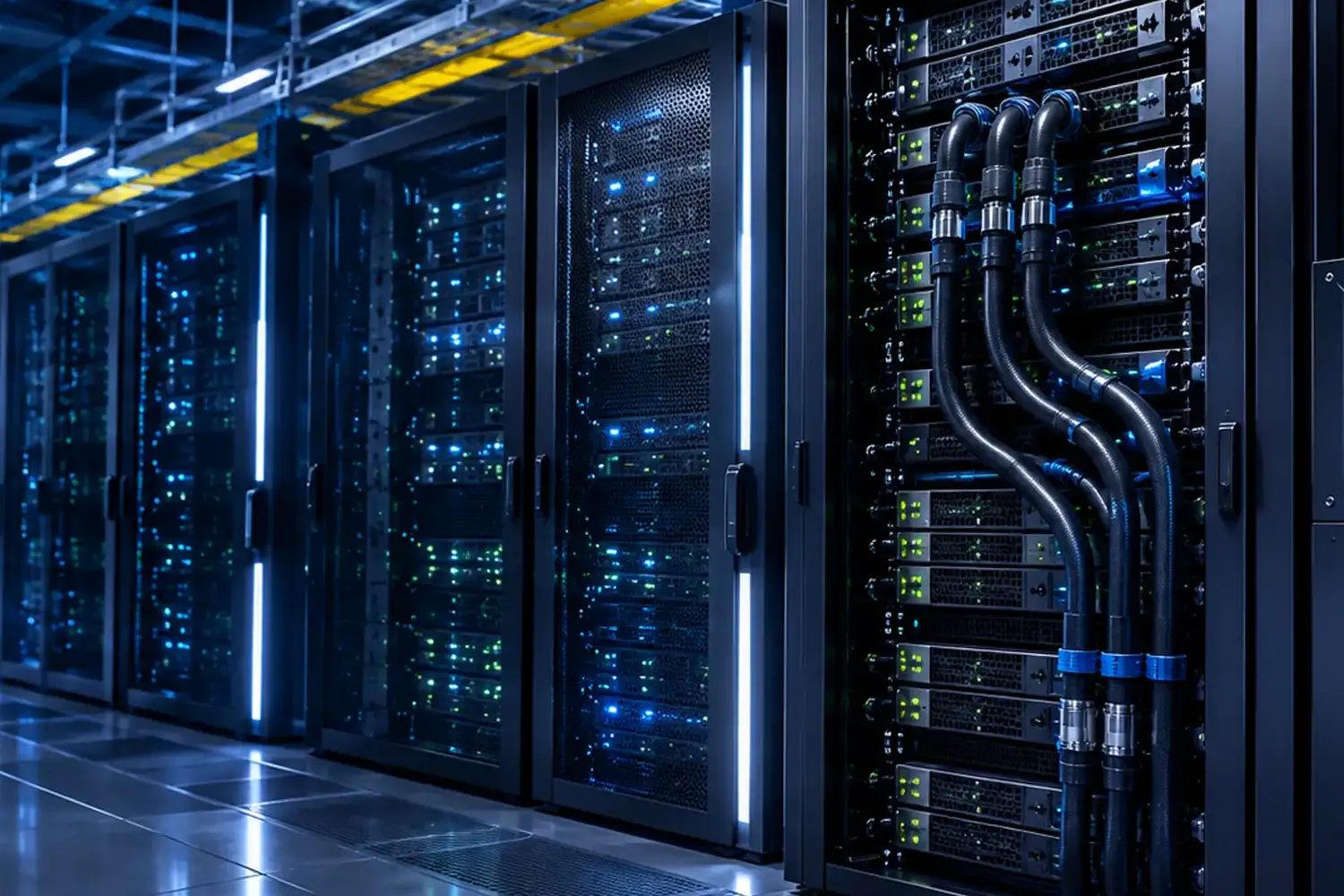
AI infrastructure is entering a new era of extreme computing density. As GPU systems become more powerful, data centers are facing a fundamental challenge: how do you deliver enormous amounts of power and remove the resulting heat without compromising reliability, safety, or efficiency?
Traditional data center racks were commonly designed around relatively modest power requirements. Modern AI workloads are changing that equation rapidly, with GPU infrastructure now pushing rack densities beyond 100kW.
According to Introl, NVIDIA’s GB200 NVL72 systems can reach approximately 120kW per rack, while future generations of AI systems are expected to push rack-level power requirements even higher.
That shift affects almost every part of data center engineering—from electrical distribution and cooling to structural design, cabling and redundancy.
The Power Challenge
A rack consuming 100kW represents a dramatically different electrical engineering problem from a conventional enterprise server rack.
At lower densities, conventional 208V distribution can be sufficient. At 100kW, however, the amount of current required becomes a major engineering concern. Introl’s analysis notes that delivering 100kW at 208V can require roughly 480 amps.
Higher-voltage distribution such as 415V or 480V three-phase systems can significantly reduce the current required for the same amount of power. This makes high-density installations more practical while reducing the amount of extremely large copper conductors required.
For facilities being designed specifically for AI workloads, power distribution therefore becomes a critical part of the architecture rather than simply an infrastructure detail.
Busway systems and advanced power distribution units can also provide greater flexibility, allowing facilities to support multiple high-density racks while making future changes easier.
Cooling Is Becoming Just as Important as Power
Every watt consumed by a GPU eventually becomes heat.
A 100kW rack therefore doesn’t simply require 100kW of electrical capacity—it also requires a cooling system capable of continuously removing approximately 100kW of thermal energy.
This is where traditional air cooling begins to reach its practical limits.
Introl explains that extremely high-density racks can require enormous airflow if conventional air cooling is used. At sufficiently high rack densities, the amount of air required becomes impractical and can consume significant energy itself.
From Air Cooling to Liquid Cooling
Rear-door heat exchangers can provide an intermediate solution for some high-density deployments. However, as rack power continues to rise, direct-to-chip liquid cooling becomes increasingly attractive.
Instead of attempting to cool the entire server environment with air, liquid cooling transfers heat directly from high-power CPUs and GPUs through cold plates and coolant loops.
This approach allows significantly more heat to be removed from a smaller physical space.
For facilities planning new AI infrastructure, liquid cooling is therefore becoming less of an optional technology and more of a fundamental design consideration.
Immersion Cooling for Extreme Density
Another approach is immersion cooling, where servers or components are placed in specially engineered dielectric fluids.
Immersion cooling eliminates much of the traditional reliance on server fans and can support extremely high computing densities in a relatively small footprint.
There are also two-phase immersion systems, where the cooling fluid changes phase as it absorbs heat and subsequently condenses back into liquid form.
These technologies remain more specialized than conventional air or direct-to-chip cooling, but their importance is growing as GPU power consumption continues to increase.
The Physical Weight of AI Infrastructure
Power and cooling aren’t the only problems.
A fully populated high-density GPU rack can weigh thousands of pounds. The weight comes not only from the servers themselves but also from power cables, networking equipment, cooling infrastructure and the rack structure.
That creates another engineering question:
Can the building actually support the equipment?
Traditional raised-floor systems may not be suitable for extremely heavy GPU racks without additional reinforcement.
High-density facilities may instead use reinforced concrete slabs, structural steel platforms or overhead support systems to distribute the load.
For data center operators upgrading an existing facility, structural engineering therefore needs to be considered alongside electrical and cooling upgrades.
Cabling Becomes a Major Engineering Problem
AI clusters also require enormous amounts of networking infrastructure.
High-performance GPU systems depend on high-speed interconnects to allow GPUs to communicate with one another efficiently. A single high-density rack can contain hundreds of power, networking, management and monitoring cables.
Poor cable management can create several problems:
- Restricted airflow
- Increased physical weight
- Difficult maintenance
- Reduced serviceability
- Signal integrity problems
- More complicated troubleshooting
As rack density increases, cable routing and documentation become increasingly important parts of the deployment process.
Redundancy Becomes Critical
The consequences of a failure become much greater when a single rack contains millions of dollars of computing equipment.
A failure involving power, cooling or networking can potentially interrupt a large AI workload and result in significant downtime.
For this reason, high-density deployments often require redundant power and cooling paths.
Independent power feeds, redundant cooling distribution units and carefully designed control systems can help prevent a single component failure from bringing down an entire workload.
The goal isn’t simply to make the system powerful.
The goal is to make it powerful, predictable and resilient.
Safety Cannot Be Overlooked
High-density GPU infrastructure also introduces serious safety considerations.
Electrical systems operating at high power can create significant arc-flash hazards. Meanwhile, liquid cooling introduces another class of risks involving leaks, containment and the proximity of coolant systems to electrical equipment.
Modern facilities therefore need multiple layers of protection, including:
- Electrical protection and arc-flash mitigation
- Leak detection
- Coolant isolation
- Early smoke detection
- Emergency power-off systems
- Proper equipment grounding
- Secondary containment
The higher the rack density becomes, the more important these systems are.
The Future of AI Data Centers
The biggest takeaway is that AI infrastructure is changing the definition of a high-density data center.
A rack that consumes 100kW would have been considered unusual only a few years ago. Today, systems at or above this level are becoming increasingly relevant to organizations deploying large-scale AI infrastructure. Introl’s analysis also points toward substantially higher rack densities in future generations.
This means data center operators cannot simply design for today’s GPU hardware.
They need to consider what the next generation will require.
That could mean installing higher-voltage power distribution, reserving capacity for liquid cooling, reinforcing floors, improving cable infrastructure and designing redundant systems from the beginning.
The Bottom Line
The evolution toward 100kW+ GPU racks is not simply a story about faster GPUs.
It is a story about power, heat, buildings, networking and engineering all converging around AI.
As computing density continues to increase, successful data centers will need to treat electrical distribution, cooling, structural capacity and reliability as one integrated system.
For organizations preparing for the next generation of AI infrastructure, designing for today’s requirements may not be enough. Future-proofing the facility for significantly higher rack densities could become one of the most important infrastructure decisions they make.
Source & Attribution
Source: Building 100kW+ GPU Racks: Power Distribution and Cooling Architecture
Author: Blake Crosley
Published: January 19, 2026
Originally published by: Introl
Read the full original article on Introl:
https://introl.com/blog/building-100kw-gpu-racks-power-cooling-architecture
Editor’s Note: This article is an original editorial adaptation based on information presented in the original Introl publication. It has been rewritten for our readers and is not a reproduction of the original article.