
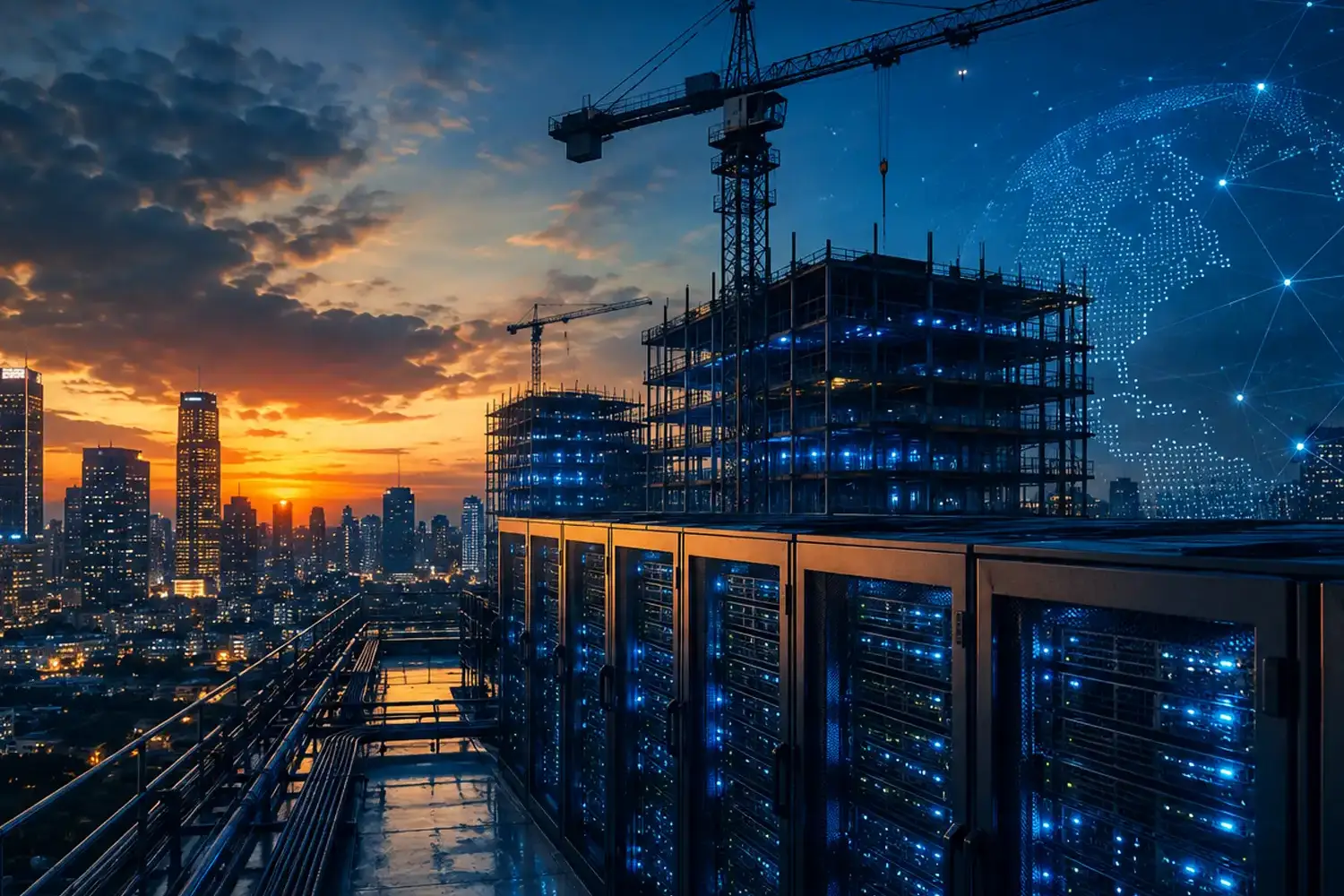
Artificial intelligence is no longer just a software story.
Behind today’s AI boom is an enormous physical infrastructure buildout involving data centers, GPUs, networking equipment, memory, cooling systems, power infrastructure and thousands of miles of supporting connectivity.
According to an analysis published by Introl, Amazon, Microsoft, Google, Meta and Oracle are projected to spend approximately $602 billion on infrastructure in 2026, representing a significant increase from the previous year. Around three-quarters of that spending is expected to be directed toward AI infrastructure.
The scale of this investment raises an important question:
How are the world’s largest technology companies financing an infrastructure expansion of this magnitude—and can the returns from AI eventually justify the cost?
AI Is Changing the Economics of Cloud Infrastructure
For years, major technology companies were primarily associated with software, online services and relatively asset-light business models.
AI is changing that.
Training and operating advanced AI models requires enormous amounts of computing capacity. That means hyperscalers must continually invest in GPUs, custom accelerators, servers, networking, data centers and power.
Introl’s analysis estimates that approximately $450 billion of the projected $602 billion in 2026 hyperscaler capital expenditure could be directed toward AI infrastructure. Traditional cloud infrastructure and other investments make up much of the remainder.
This represents a major transformation in capital intensity.
The companies building the world’s AI infrastructure increasingly resemble large industrial infrastructure operators—because their growth depends not only on software but also on physical facilities and equipment.
The Five Hyperscalers Driving the Buildout
The spending is concentrated among five major companies:
- Amazon
- Microsoft
- Meta
- Oracle
Each company is approaching the AI infrastructure race somewhat differently.
Amazon is expanding AWS capacity while also investing in its own AI accelerators such as Trainium and Inferentia.
Microsoft is expanding Azure’s AI capacity and its global data-center footprint.
Google is investing heavily in both data centers and its custom TPU accelerators.
Meta is building enormous infrastructure to support its AI models and Llama ecosystem.
Oracle, although smaller than the other hyperscalers, is aggressively expanding its cloud infrastructure to compete for AI workloads.
The result is a massive increase in demand for virtually every component required to build an AI data center.
Where Is the Money Going?
The projected AI infrastructure spending isn’t going into a single category.
It is distributed across an enormous ecosystem.
According to Introl’s analysis, approximately:
| Infrastructure Category | Estimated 2026 Spending |
|---|---|
| GPUs & Accelerators | ~$180B |
| Data Center Construction | ~$120B |
| Networking | ~$50B |
| Memory | ~$40B |
| Cooling | ~$25B |
| Power Infrastructure | ~$20B |
| Other Infrastructure | ~$15B |
This demonstrates how AI investment extends far beyond buying GPUs.
Every new GPU cluster requires buildings, electrical systems, networking, cooling, backup power, physical security and extensive deployment infrastructure.
In other words, AI demand is becoming an infrastructure supply-chain story.
Data Centers Are Becoming Power Plants in Their Own Right
One of the biggest challenges is the amount of electricity required to operate modern AI facilities.
Introl estimates that the projected data-center construction spending could translate into approximately 15–20 GW of new data-center capacity and hundreds of new facilities globally.
That level of demand puts pressure on utilities and energy developers.
Traditional utility planning can take years, while AI companies are attempting to bring computing capacity online much faster.
This is encouraging interest in several approaches, including:
- New utility-scale generation
- Renewable energy projects
- Nuclear power agreements
- Power purchase agreements
- On-site generation
- Behind-the-meter power systems
The AI infrastructure race is therefore also becoming an energy infrastructure race.
The Hidden Bottleneck: AI Hardware Supply
Even when companies have the money to build new AI infrastructure, they still need the hardware.
And some of that hardware is in extremely limited supply.
High-Bandwidth Memory
High Bandwidth Memory, or HBM, is particularly important for modern AI accelerators.
Advanced GPUs require enormous amounts of high-speed memory to process AI workloads efficiently.
However, HBM manufacturing is significantly more resource-intensive than conventional memory production. Introl’s analysis highlights HBM availability as one of the major constraints on AI infrastructure deployment.
That means adding more data centers doesn’t necessarily solve the problem.
The industry also needs sufficient memory manufacturing capacity.
Advanced Chip Packaging
Another important bottleneck is advanced semiconductor packaging.
Technologies such as TSMC’s CoWoS packaging are essential for assembling today’s high-performance AI processors.
If chip manufacturing expands faster than packaging capacity, the packaging stage can become the limiting factor.
This creates an unusual situation:
The industry can have enormous amounts of capital available while still being unable to deploy infrastructure as quickly as planned.
Debt Is Becoming Part of the AI Infrastructure Strategy
The scale of AI spending also creates a financial challenge.
Hyperscalers have historically generated enormous amounts of cash, allowing them to fund significant portions of their infrastructure expansion internally.
But the size of today’s investment cycle is changing that equation.
Introl reports that technology companies issued approximately $428 billion in bonds during 2025, while the major hyperscalers collectively added roughly $121 billion in new debt.
Companies including Meta, Alphabet and Oracle have made significant debt-market moves to support infrastructure expansion.
Future borrowing could become even larger if AI infrastructure spending continues at the projected pace.
This creates a new dynamic for the technology sector:
AI growth is increasingly being financed not only by operating cash flow, but also by the global credit markets.
The Big Question: Will AI Generate Enough Revenue?
This is where the story becomes more complicated.
The infrastructure investment is enormous, but the revenue generated directly from AI services is still developing.
Introl’s analysis highlights a significant gap between current AI-related revenue and the amount being invested into AI infrastructure.
For hyperscalers, the assumption is that AI demand will continue accelerating.
Businesses will use more AI APIs.
More companies will deploy AI agents.
Inference workloads will increase.
AI-powered applications will become part of everyday business operations.
And demand for cloud computing will continue to grow.
If those assumptions are correct, today’s infrastructure spending could provide the foundation for substantial future revenue.
But if AI adoption grows more slowly than expected, companies could face a difficult situation involving expensive infrastructure, large depreciation costs and increasing debt obligations.
Utilization May Matter More Than Raw Capacity
Building more GPUs does not automatically mean generating more revenue.
The GPUs need to be utilized.
AI training workloads can be highly intensive but may not operate continuously at maximum capacity. Inference workloads could eventually provide a more consistent source of demand as AI applications become widespread.
This makes GPU utilization one of the most important metrics to watch.
A data center filled with expensive accelerators that remain underutilized could become a significant financial burden.
Conversely, consistently high utilization could dramatically improve the economics of the infrastructure investment.
The next phase of the AI race may therefore be less about simply acquiring more GPUs and more about using them efficiently.
What This Means for Data Center Infrastructure
The AI buildout creates enormous opportunities for companies involved in physical infrastructure.
Data-center developers, electrical contractors, networking specialists, cooling companies and equipment manufacturers are all facing increased demand.
But the opportunity also comes with risk.
A large portion of the new infrastructure demand is concentrated among a relatively small number of customers.
If hyperscalers reduce capital spending, the effects could ripple through the entire supply chain.
Infrastructure companies therefore need to balance growth with diversification, capacity planning and financial discipline.
Speed Is Becoming a Competitive Advantage
Another major change is the speed at which AI infrastructure needs to be deployed.
Traditional data-center development can take years.
The current AI race is pushing developers and operators to compress those timelines dramatically.
That creates pressure across the entire project:
Power → Construction → Cooling → Networking → Hardware → Commissioning
A delay in any one of these areas can prevent an entire AI facility from becoming operational.
This is why supply-chain management and project execution are becoming just as important as the underlying technology.
The AI Infrastructure Race Is Just Beginning
The projected $600 billion spending level represents more than an enormous technology investment.
It signals a fundamental change in how computing infrastructure is built.
AI is creating demand for:
- Massive GPU clusters
- High-density data centers
- Advanced liquid cooling
- High-voltage electrical infrastructure
- New power generation
- High-speed networking
- HBM memory
- Advanced semiconductor packaging
- Specialized construction
- New financing models
And these requirements are interconnected.
More GPUs require more power.
More power produces more heat.
More heat requires better cooling.
More computing capacity requires more networking.
More facilities require more electricity.
And all of it requires capital.
What Comes Next?
The most important questions for the next few years aren’t simply about how many GPUs companies can purchase.
The bigger questions are:
Can AI revenue grow quickly enough to justify the infrastructure investment?
Can semiconductor and memory suppliers expand quickly enough to meet demand?
Can utilities provide enough electricity?
Can hyperscalers continue borrowing at the current pace?
And can data-center developers build infrastructure fast enough to keep up?
The answers will determine whether today’s enormous AI infrastructure spending becomes one of the most successful technology investments in history—or an infrastructure cycle that ultimately proves too aggressive.
For now, one thing is clear: the AI revolution is no longer happening only inside computers. It is being built in data centers, power plants, semiconductor factories and construction sites around the world.
Source & Attribution
Source: The $600B AI Infrastructure Buildout: Hyperscaler CapEx, Debt, and Supply Chain Reality
Author: Madison Kersh
Originally published by: Introl
Read the full original article on Introl
Editor’s Note: This article is an original editorial adaptation based on information presented in the original Introl publication. It has been rewritten for our readers and is not a reproduction of the original article.
The source page currently identifies Madison Kersh as the author and discusses the $602 billion 2026 projection, $428 billion in 2025 technology bond issuance, supply-chain constraints, and the broader financial and infrastructure implications of the AI buildout.